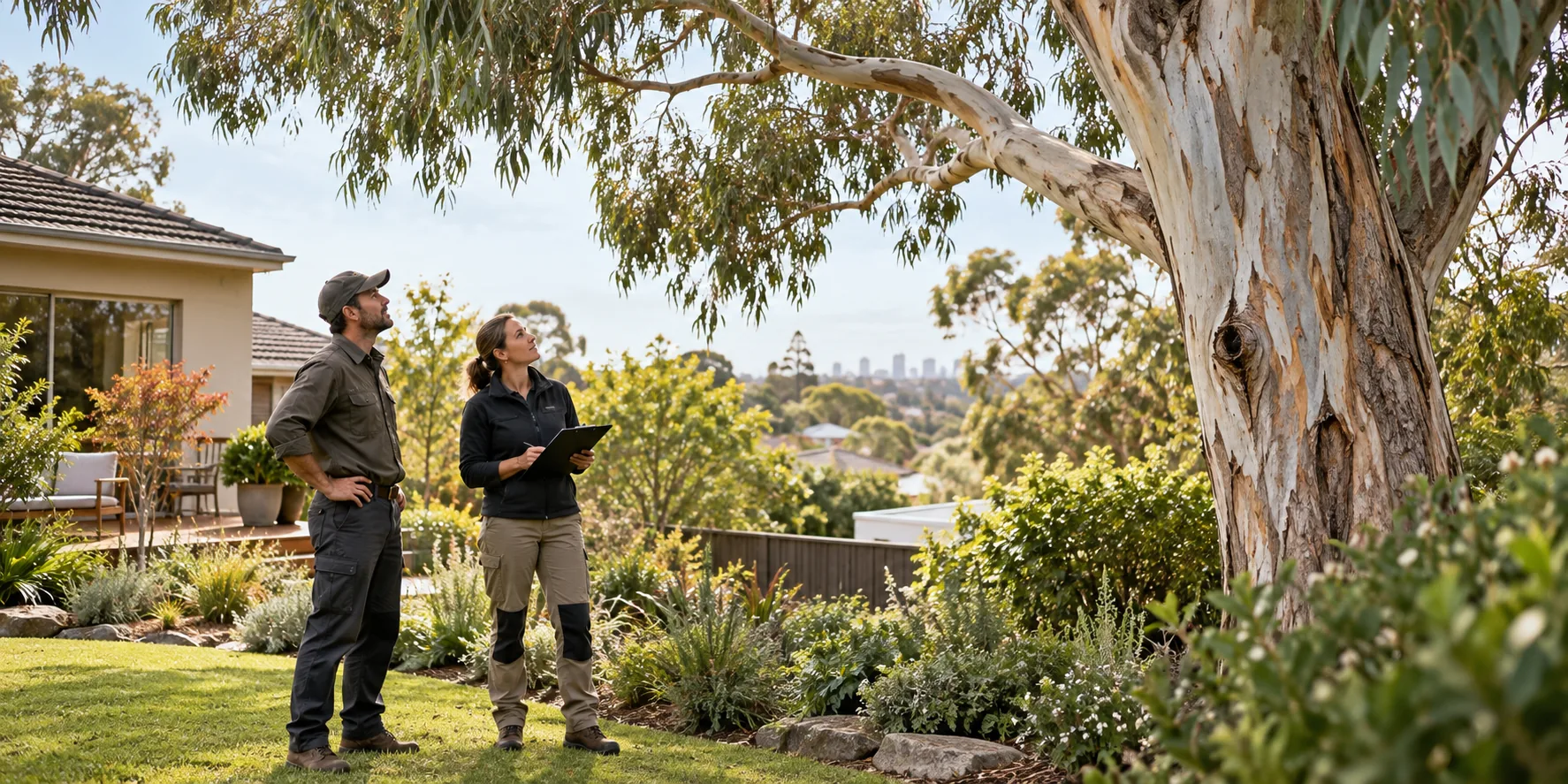

Managing trees across a rental, commercial or managed property can involve more than booking someone to cut branches. The first challenge is often working out what the problem is, how it affects the property and what type of tree work is appropriate.
Our approach to property manager tree services in Melbourne starts with the tree, the reason for the enquiry and the surrounding site. That may include buildings, fences, driveways, paths, outdoor areas and other structures close to the tree. The aim is to understand what needs attention before deciding how the work should be approached.
This can be useful when you are responding to a tenant or owner request, dealing with overgrown or damaged branches, planning routine tree maintenance or trying to clarify the scope before seeking approval for work.
If you manage a property with a tree concern, you can contact us with what has been reported and the property details. You do not need to diagnose the tree before making an enquiry.
When property manager tree services may be needed
Tree issues on managed properties can appear as maintenance requests, safety concerns, access problems or complaints about how a tree is affecting the use of the property.
Common situations can include:
- branches growing towards a roof, fence or other structure
- overgrown branches affecting a driveway, path or outdoor area
- dead, damaged or deteriorating limbs that need closer attention
- dense or unbalanced growth that has become difficult to manage
- trees that have been neglected between maintenance visits
- branches affected by strong wind or storm conditions
- trees that appear to have changed in condition
- recurring branch growth in areas that need to remain clear
- trees that have become too large or difficult for straightforward garden maintenance
- a tenant, owner or site contact reporting a tree concern without knowing which service is required
For property managers, the visible problem is only part of the job. You may also need to understand what work is proposed, why it is appropriate and whether another party needs to approve it.
A clear starting point helps avoid treating every complaint as a removal job or every overgrown tree as a simple trimming job. Different tree problems can require different responses.
A maintenance request may point to a more specific service
A request such as “please trim the tree” can describe several different problems. The branch may need clearance from a building. Deadwood may need to be removed. The canopy may need selective pruning. A damaged limb may need assessment before work is decided.
Understanding the reason behind the request helps define the service more accurately.
What property manager tree services involve
Property manager tree services can involve assessing the reported issue, understanding the property around the tree and identifying the type of work that may be suitable.
The exact service depends on the tree and the problem. It may involve pruning problematic growth, removing specific branches, addressing deadwood, considering the condition of the tree or discussing whether a different service is required.
Important factors can include:
- the type and apparent condition of the tree
- the size and position of the branches involved
- the reason the work has been requested
- nearby buildings, roofs, fences and other structures
- paths, driveways and areas used by occupants or visitors
- access to the tree and the work area
- whether the concern is maintenance-related or connected to visible damage
- how much work is appropriate for the issue
This is why it helps to define the problem before defining the solution.
Tree pruning and maintenance
Pruning may be appropriate where selected growth needs to be managed for clearance, tree form, dead or damaged branches or general maintenance. The scope should relate to the reason for the work rather than simply removing as much growth as possible.
For pruning-specific commercial needs, see our commercial tree pruning Melbourne page.
Branch removal
A particular limb may be the main concern rather than the whole canopy. This can occur when a branch is damaged, dead, poorly positioned or growing into an area that needs clearance.
Our tree branch removal Melbourne page explains that service in more detail.
Tree condition and risk concerns
Sometimes the concern is not simply branch growth. A property manager may receive a report about visible deterioration, unusual movement, damaged limbs or another change that raises questions about the tree.
A tree health assessment focuses on apparent condition and health concerns, while a tree risk assessment is more specifically concerned with potential failure and what could be affected if failure occurs.
These are different questions from routine pruning.
Tree removal
Removal is a separate service and should not be treated as the automatic answer to every difficult tree. The tree, its condition, its position and the reason removal is being considered all matter.
Where removal is the issue, see tree removal Melbourne.
How we approach tree work for property managers
Property managers need enough information to move a maintenance issue forward without having to become tree specialists themselves.
Our approach starts with the reason for the enquiry. We consider what has been reported, what is visible at the property and what the tree is affecting. From there, the work can be considered in the context of the site rather than as an isolated tree task.
Start with the problem being reported
The initial request might come from a tenant, owner, building manager, maintenance contractor or routine inspection. Their description is useful, but it may not identify the correct tree service.
Details such as where the branch is located, what it is affecting and whether damage is visible can help clarify the concern.
Photos may also help communicate the issue initially, although they do not necessarily show everything relevant to the tree or site.
Consider the tree and the property together
The same branch can create different practical issues depending on where it is located.
Growth above an open garden bed is different from growth above a roof, parked vehicles, a shared entrance or a frequently used path. Access may also affect how a job needs to be considered.
Looking at the surrounding property helps connect the tree work to the actual reason the job has been raised.
Define the scope before unnecessary work is added
Property maintenance is easier to manage when the proposed work has a clear purpose.
If the problem is a small number of branches affecting clearance, the scope should reflect that. If the concern relates to deadwood, damaged growth or the condition of the tree, that should be identified rather than hidden inside a vague request for “tree trimming”.
A clearer scope also gives property managers something more useful to communicate to owners or other stakeholders when approval is required.
Keep separate issues separate
One property can have several trees with different needs. Even one tree can have more than one concern.
A maintenance issue, a health concern and a potential risk concern are not automatically the same thing. Separating them can make the next step easier to understand and reduce unnecessary work.
Property manager tree services around Melbourne properties
Managed properties across Melbourne can place trees close to buildings, boundary fences, parking areas, driveways, shared paths and outdoor spaces. That can make tree maintenance a property-management issue as much as a garden issue.
A tree does not need to be unusually large to create a practical problem. Branches can gradually extend towards gutters, roofs or access areas. Dense growth can affect how an outdoor space is used. Dead or damaged limbs may be reported by occupants. Storm conditions can expose damage that was not previously obvious.
The appropriate response depends on the property and the tree rather than the suburb name alone.
Confirm service availability for the property address when making an enquiry.
Rental properties
For rental properties, the property manager may be coordinating between the occupant and the owner. A useful scope needs to explain the tree issue in practical terms so the person approving the work can understand what is being addressed.
Access also matters. Trees may sit in backyards, beside garages, near fences or in other parts of a property where entry needs to be arranged with the occupant.
Commercial and mixed-use properties
Commercial properties can add further considerations such as parking, customer access, delivery areas and spaces used throughout the day.
Where the requirement is broader than property-management coordination, our commercial tree services Melbourne page covers commercial tree-care needs in more detail.
Shared properties and owners corporations
Shared property can involve common areas and several stakeholders. That creates a different management context from a single rental property.
For those needs, see body corporate tree services Melbourne.
Who property manager tree services are for
This page is intended for people responsible for organising tree work on property they manage rather than necessarily occupy themselves.
That can include:
- residential property managers
- real estate professionals coordinating maintenance
- landlords and property investors managing through an agent
- facilities managers
- commercial property managers
- people responsible for common or shared property
- maintenance coordinators dealing with tree-related requests
The common issue is responsibility for moving a tree problem from report to practical action.
You may know exactly what service is required, or you may only have a message saying that a tree is “overgrown”, “unsafe”, “hitting the roof” or “needs cutting back”. Either is a reasonable starting point.
What to expect when arranging tree work for a managed property
The process should begin by establishing what the concern is and where the tree is located.
A typical enquiry may involve the following steps.
1. Tell us what has been reported
Provide the property details and describe the concern as clearly as you can. If the request came from a tenant or site contact, their description can be used as the starting point.
Useful information may include whether branches are affecting a building, access area, fence, driveway or another part of the property.
2. Discuss the likely service requirement
The reported issue can then be considered against the type of tree work that may be relevant. This helps distinguish routine pruning from branch removal, assessment or another service.
You do not need to choose the technical service before making contact.
3. Assess the work and site considerations
The tree, surrounding property and access need to be considered before the scope is settled. The amount and type of work should relate to the problem being addressed.
4. Confirm the proposed scope
A clear scope helps a property manager understand what work is being proposed and communicate it to an owner or other decision-maker where necessary.
If there are separate concerns, they should be identified rather than combined into an unclear general instruction.
5. Arrange the work
Once the scope and relevant arrangements are understood, the work can be organised subject to availability, access and any other requirements that apply to the property.
No specific response time, attendance window or ongoing maintenance arrangement should be assumed unless it has been confirmed for the job.
Safety and property considerations
Tree work around managed properties can affect more than the tree itself. The surrounding site may include occupants, neighbouring properties, buildings, parked vehicles, fences, pathways and other areas that need to be considered.
Branches near buildings
Branches growing towards a roof, gutter, wall or other structure should be considered in relation to the specific clearance problem. Cutting branches without understanding the tree or the required outcome can create unnecessary work or poor pruning decisions.
Dead or damaged branches
Dead, broken or deteriorating limbs can require attention, particularly where people or property may be below them. The appropriate response depends on the branch, tree and location.
If the issue specifically involves dead branches, see deadwood removal Melbourne.
Storm-affected trees
Strong winds can break limbs, alter branch positions or leave damage that needs assessment. A storm-damaged tree should not automatically be assumed to require removal.
Our storm damaged tree services Melbourne page covers post-storm tree concerns separately.
Avoid hazardous DIY work
Property managers and occupants should not be encouraged to climb trees, work at height or attempt to cut large or difficult branches themselves.
Where a branch or tree is in contact with electrical infrastructure, or another immediate public hazard exists, the relevant utility or emergency authority may need to be contacted rather than treating it as routine tree maintenance.
Access and occupied properties
Access is an important part of managed-property work. A tree may be behind a locked gate, within a tenant’s yard, beside a car park or close to an area used by customers or residents.
Those practical details can affect how the job is arranged and should be raised early rather than discovered when work is due to begin.
Council rules and permits for tree work on managed properties
Tree controls can vary between Victorian councils and between individual properties. Planning overlays, protected-tree provisions or other local requirements may affect what can be done to a particular tree.
There is no single Melbourne-wide rule that means all pruning or removal work can proceed without checking local requirements.
For property managers, this is particularly important because the person arranging the work may not be the property owner. If approval or permission is required, responsibility for obtaining it should be clear before work proceeds.
The relevant council and property circumstances should be checked where there is uncertainty. A general service page cannot determine whether a permit is required for an individual property.
If formal written tree information is required for a council, planning or property matter, that may be different from arranging physical tree work. See arborist reports Melbourne for more information about report-related enquiries.
How to choose a tree service provider for a managed property
Property managers are often comparing more than a price. The provider also needs to understand what is being requested and give enough clarity for the job to be approved and coordinated.
Useful questions include:
Can they explain what work they are proposing?
A quote or scope is more useful when it identifies the tree issue and the work intended to address it. Vague descriptions can make approvals and comparisons harder.
Are they separating maintenance from assessment?
Pruning an overgrown branch and assessing a concern about tree condition are different tasks. A provider should not blur every tree problem into the same service.
Have they considered the surrounding property?
Buildings, access, fences, paths and occupied areas can all be relevant to the job. The tree should not be considered without its surroundings.
Are their qualifications and insurance appropriate for the work?
Ask for current evidence where qualifications, insurance or specialist credentials are relevant to the service. Ask for evidence of any credentials relevant to the job.
Are council or permit claims specific to the property?
Be cautious of broad claims that a permit is always required or never required. Local rules and property controls can vary.
Common questions about property manager tree services in Melbourne
What tree services do property managers usually need?
Common needs can include pruning overgrown branches, managing clearance, removing specific damaged or dead branches and responding to concerns about tree condition. The correct service depends on the problem at the individual property.
Do I need to know whether the tree needs pruning or removal before I enquire?
No. Start with what has been reported and what the tree is affecting. The purpose of the initial discussion is to clarify the issue before the scope is decided.
Can you deal directly with a tenant?
Access and communication arrangements need to be confirmed for each job. Do not assume a particular tenant-contact or property-access process until it has been agreed.
Can tree work be quoted from photos?
Photos can be useful for showing the general concern, branch position or surrounding property. They may not show every factor needed to define the work, particularly for larger trees, access constraints or concerns about tree condition.
How much do property manager tree services cost in Melbourne?
The cost depends on the actual service required and the job conditions. Tree size, branch size, access, surrounding structures and the amount of work can all affect scope. A general price should not be used as a substitute for understanding the job.
Can you provide ongoing tree maintenance for managed properties?
Ongoing or scheduled maintenance arrangements have not been established as a confirmed service offering here. Where repeat maintenance is required, the appropriate arrangement should be discussed for the property rather than assumed.
Do you provide tree risk assessments for managed properties?
A risk assessment is a more specific service than routine maintenance. It considers potential tree or branch failure in relation to what could be affected. See tree risk assessment Melbourne for the scope of that service.
Do property managers need council permission before arranging pruning?
Not in every case, but rules can vary by council, property and tree. Check the requirements that apply to the specific property where there is uncertainty rather than relying on a Melbourne-wide assumption.
What if a tenant reports a tree as dangerous?
Treat the report seriously, but do not assume the word “dangerous” is a diagnosis. Gather the available information, avoid the affected area where there is an immediate concern and arrange appropriate assessment or assistance based on the situation. For urgent tree situations, see emergency tree services Melbourne.
Is property manager tree work different from commercial tree services?
There can be overlap. This page focuses on the coordination and decision-making needs of people managing properties for others. The commercial tree services Melbourne page is broader and covers tree-care needs across business and commercial properties generally.
Arrange tree services for a Melbourne property you manage
If a tenant, owner or site contact has raised a tree issue, you do not need to diagnose it before making an enquiry.
Tell us what has been reported, where the tree is located and what part of the property it is affecting. From there, the concern can be considered in the context of the tree, the site and the type of work that may be appropriate.
For property managers, a clear scope makes the next step easier to communicate and approve. The aim is to address the actual tree problem without adding unnecessary work or treating every issue as the same service.
Contact us to discuss the tree concern at the property you manage.